Donate your RMD Tax-free to Charity


For nearly a decade the rules allowing for a tax free Qualified Charitable Distribution (QCD) from an IRA to a charity has been an on-again off-again part of the infamous Tax Extenders that would lapse and be reinstated every other year.

The Protecting Americans From Tax Hikes (PATH) Act was passed in 2015, finally making the QCD rules permanent, thus making it easier to engage in proactive charitable giving strategies.

What is an RMD?  A Required Minimum Distribution – a distribution an owner of an IRA is required to take by April 1st, a year after one is 70 ½.  Gifting your RMD to charity helps to minimize the tax bite.

However, obtaining the tax benefits for effecting a QCD from your IRA to a charity requires meeting a few specific requirements, such as being 70 1/2 or older, the maximum gift per year is $100,000 and you may only gift to public charities.

In addition, the most important requirement is that the check must be made payable directly to the charitable entity, not to the owner of the IRA.


Tax Benefits of gifting your IRA to a charity:

You will NOT pay Ordinary Income Tax on the IRA Distribution

The RMD is NOT counted as Gross Adjusted Income

The distribution qualifies as a Qualified Charitable Distribution


How to make the RMD to a Charity:  Very Easy

You must be 70 ½ at the time of the distribution

Submit a distribution form from the custodian of your IRA, for example: we work with Schwab – their form is simplified – you decide on the amount of the gift and the address of the organization

The custodian, such as Schwab will send a check DIRECTLY to the Charity

You should call the Charity to alert them to the gift, so the charity will then know who the gift is from, a letter of acknowledgement of your gift should be sent for your tax records.


Donating your RMD is a win – win for you and the charity – you will receive a nice tax break, reduce your adjusted gross income and the charity receives a great gift!!


Written by: ||elizabeth genter, schenley president||


Real Estate REIT’s


     Many dream to own real estate, whether it be a property for rental income, a second home, store front, a hotel, shopping mall, or office building complex. But, having collateral and upfront funds to invest, develop, and manage is not an easy task. Adding liquid Real Estate or REIT’s to your investment portfolio allows you to own part of a shopping mall, hotels, commercial office space, or even apartment rental complexes while diversifying your investment portfolio! So, what is an REIT and how do you choose one to invest in?

     REIT stands for Real Estate Investment Trust. An REIT is a type of investment comparable to a mutual fund. Small and large investors can now own a small part of a real estate venture and even technically collect rental income! There are two types of REIT’s: Equity REIT’s and Mortgage REIT’s. Equity REIT’s generate income by collection of rent, and from sales of properties that are owned long term. Mortgage REIT’s invest in mortgage securities from commercial and/or residential properties. REIT’s usually pay out as taxable income generated by the property to shareholder’s in the funds dividends. The shareholder pays taxes on those quarterly dividends they receive. Owning shares in a REIT can be rewarding! A REIT usually pays an attractive amount in income every quarter. An investor can buy and sell REIT’s daily, making them a very liquid investment.

Some well knows REIT’s are Public Storage (PSA), which is a company that has self-storage facilities all over the United States. Another well-known REIT that has properties in our local area is Simon Property Group (SPG). Two familiar properties are Ross Park Mall and Grove City Outlets. 

     Do you have Real Estate REIT’s in your current investment portfolio? If not, speaking with an investment advisor would be the first step!Schenley Capital believes diversification is a key principal for your investment portfolio.We would like to assist in reviewing your current portfolio to select a customized mix of investments for you.We offer a free portfolio review. Contact us to schedule your personal portfolio review!


Written by: ||cassandra hartman, office manager||

Small Cap

Small-cap stand for “Small market capitalization”. Market Capitalization is the estimation of a company’s value or size through multiplying the number of shares outstanding times the share price of the stock. An example of this would be to look at Consol Energy- a Small-cap company. Consol Energy has 230 Million shares of stock priced at $16.95 as of market opening on October 3rd. This puts them at a market valuation of 3.8 Billion dollars. Small cap stocks are shares of a company with a market capitalization value range of about $300 million to $2 billion.

Small cap companies are not necessarily “small”, they are established companies but dwarfed in comparison to larger companies like Coca-Cola and Facebook. So why own small-cap stocks? Small-cap stocks offer more opportunity for growth as they increase their product or service and are growing their market share. Small caps do offer high growth potential although they can be susceptible to market swings. This can be an advantage when the market is up, but a disadvantage when the market is down because they are more susceptible to the negative changes in the market as well as the positive, so more risk is involved.

Many small cap companies create components for larger companies, such as computer parts or automobile parts. Guidewire Software (GWRE) is one example that provides property and casualty software insurance to industries. Another example is Inogen (INGN) which is a medical technology company which develops and manufactures portable oxygen concentrators that provide oxygen therapy to patients suffering from chronic respiratory conditions. Other examples of Small-cap companies are Sonic(SONC), Federated Investors(FII), Chipotle(CMG), and Papa John’s(PZZA).


Written by: ||lauren pearce, associate||

Large Cap

Large Cap stands for “Large market capitalization”. Market Capitalization is the estimation of a company’s value or size through multiplying the number of shares outstanding times the share price of the stock. An example of this can be demonstrated through looking at Walt Disney. Walt Disney has 1.544 Billion shares and the share price is $100.05 as of market opening on Oct. 3, this puts their valuation at 154.50 Billion dollars. Large cap stocks are simply a share of a large company with a market capitalization value of around 10 billion or above. Walt Disney would be considered a large-cap company and is part of the 30 companies which make up the Dow Jones Industrial Average. Other examples of Large-cap companies include Apple(AAPL), CVS Pharmacy(CVS), Amazon(AMZN), and Coca-Cola(KO). The advantage of owning large cap in your portfolio is that they are typically more stable and they offer dividends, which pay you a portion of your money back when the company earns a net profit. The disadvantage of large cap companies is that the return on investment is not as high as a smaller growth company because the growth is steady and the companies are well established.


Written by: ||lauren pearce, associate||

Asset Class

An asset class is a categorization of assets by their similar financial characteristics, behaviors in the market, and laws and regulations to which they are subject. The main asset classes are stocks, or equities; bonds, or fixed income; and cash equivalents, or money market instruments. Different asset classes are used to vary portfolio investments because each class is expected to reflect different percentages and rates of return on your money. Large US Companies, like Coca-Cola (KO), are mature consumer product companies which usually have a more stable stock price. Small US companies are typically more volatile to market changes, which means their stock price will increase or decrease more quickly than a large company’s stock price. Other examples of asset classes would include: Emerging Markets, Large European companies, Real Estate, and different types of bonds.


Written by: ||lauren pearce, associate||


What is Diversification?

You’ve probably heard the phrase: “Don’t put all of your eggs in one basket” and maybe you wonder what that concept really means for your finances. Diversification is splitting your investments into different “baskets” in order to reduce the risk of losing all your “eggs” or money, if one basket falls or performs poorly. An asset allocation strategy is a key element to developing an investment plan. The asset allocation represents decisions about what percentages of a portfolio to allocate to various categories such as stocks, bonds, and cash. Whether you are a more aggressive or conservative investor, all well balance portfolios will hold an appropriate amount of stocks and bonds in mutual funds. A diverse portfolio includes multiple investments to reduce the adverse effects of a quick downturn in the market and to participate in the reward of an upside market movement.

A practical example of a diversified portfolio may have 60% in stocks and 40% in bonds,

or 70% in stocks and 30% in bonds.

Do you hold a large amount of a stock that was given as a gift to you from a family member?  Do you know how diversified your portfolio is? Do you know what percentage of equity and fixed income you currently hold?

At Schenley we create an overall strategy and pick specific investments which would have the right balance for your goals. We would be happy to review your investments and see if your asset allocation is diversified in a way that meets your needs. 


Written by: ||lauren pearce, associate||

Cyber Security and Non-Profits


     Cyber security is a very sensitive subject these days. Many are aware that a data breach can happen, but many still think “It will never happen to us.” or “Our non-profit is too small, security breaches only happen to larger organizations”.  Small, medium, or large; every non- profit should take proper measures to make sure their donor data is secure from a cyber breach.

   Three questions every nonprofit should ask themselves:

-Do we process donations or event registrations with payment on our website?

-Do we save and store personal information of our employees, volunteers and donors? (personal information being- employee records, social security numbers, driver’s licenses, addresses, bank account numbers for direct deposit for employees, and donation payment information, such as card numbers, checking account numbers, and even investment account numbers from stock gifts.)

-Do we collect and store information about our donors, subscribers to newsletters, and patrons/ event attendees?

If you answered YES to any of these questions, you are at risk for a data breach! So, what can your organization do and what are the next steps to make sure your non-profit is more secure?

     First, assess your risks and review the places that could result in a data breach, then implement a data security plan. When collecting and storing data…where is it stored… the cloud or customized data entry system for your organization that is saved in house? How do we collect the info we store? And finally, who oversees managing the collected data for donors, event attendees, and even employees? Is sensitive information only available to a limited amount of organization members? Training all employees and volunteers to collect and dispose of information correctly and carefully will help aid in preventing a data breach.

     Many nonprofits employ help to maintain their company from outside sources like bookkeeping, IT, payroll, and even data backup and storage. Some organizations collect and process donations thru a third-party source, which may not be as secure and can be breached. Not only is protecting in house data important, making sure all third-parties have a very strong data security plan in place as well, will protect your non-profit from a third-party data breach.

How does your organization prevent data breaches?

Tips for secure passwords:

-Changing passwords for all software which contains donor, event attendee, and employee data

-Make passwords the longest length allowed (example 8 characters, 12, characters, 16 characters)

-Change any password with an employee’s name, the word “admin”, or any other basic information

-Use upper and lower-case letters, numbers, and symbols to make your password complicated

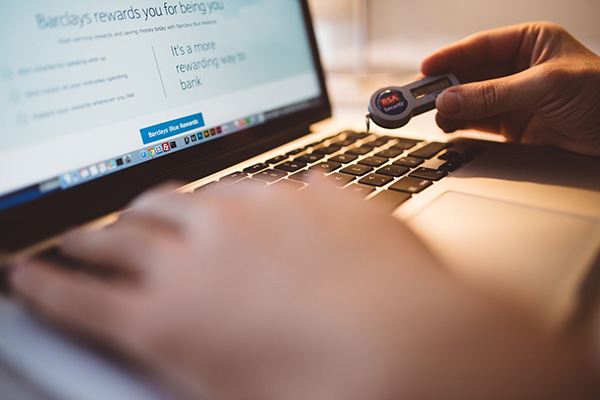
-Add a password authenticator encryption device like a 6-digit code generator (These authenticators are very easy to use. You can even download an app for one on your smart phone!)

Tips for Website Security:

-All nonprofits accepting donations or event attendance payments through your website-choose a secure company to accept, process, and transfer funds to your account

-Change your website back office password with a lengthy password with letters, numbers, and symbols

-Add encryption to your website back office password (This authentication device will help prevent any hackers from taking over your website, redirecting donations and payments to another account, and hurting your sites credibility)

     You can protect your non-profit from a cyber security breach by assessing risks, training all employees and volunteers on how to securely handle data, and making sure all third-parties securely handle your data. These measures will help your organization prepare and will help prevent a cyber security attack in the future. While unforeseen instances may occur, being prepared for them by having a security plan and even investing in cyber liability insurance may help your non-profit to be protected from an unforeseen event! A few upcoming Schenley blogs will be on the topic of Liability Insurance, what is it, and how much coverage would your non-profit need to be protected? Don’t forget, Schenley can review your organizations investment portfolio and insurance! Call us for your organizations personal review today!


Written by: ||cassandra hartman, office manager||

schenley second quarter review 2017

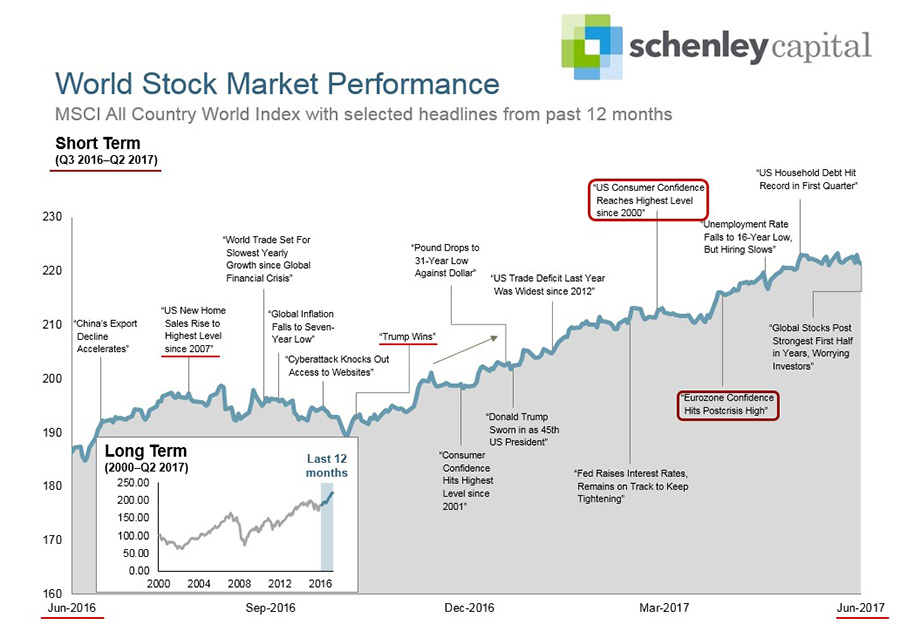
As the second Quarter of 2017 has ended and companies are now releasing earnings, we have a quick review of how things shaped up for the quarter.


The biggest winners for the quarter:

The FANG – Facebook, Amazon, Netflix and Google and Apple – are the real leaders in the US markets

These high profitability stocks outperformed among large and small stocks

US Large Cap:

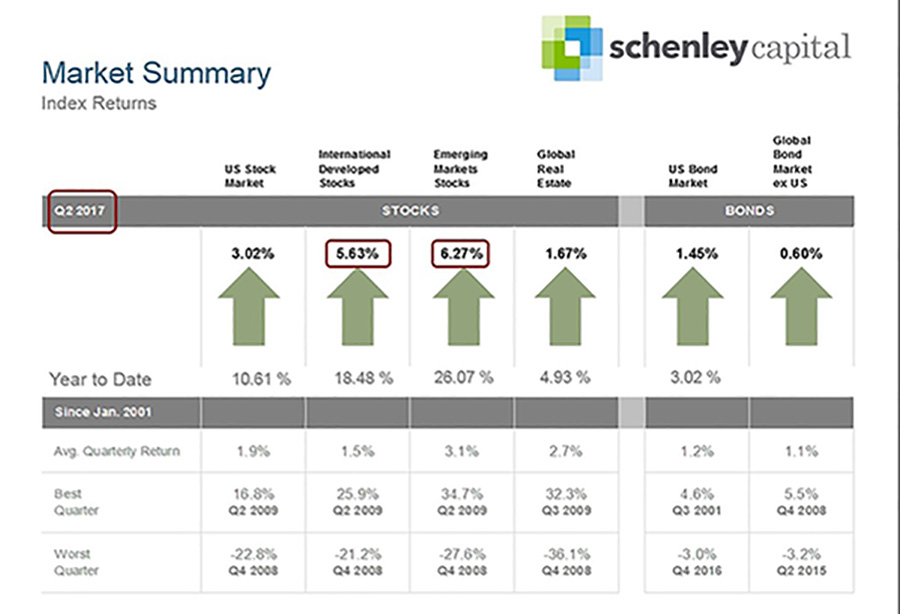
US large Companies have returned 3.02% for the 2nd Quarter and 10.34% YTD

Emerging Markets:

Emerging Markets is the growth story for 2017 – returning 6.27% in the 2nd and 25.69% Year to Date (YTD)

Large Cap International:

Large International markets have returned 5.63% in the 2nd  Quarter and 17.83% YTD

Real Estate:

The global real estate markets returned 1.67% in the 2nd Quarter and 3.82% YTD

Fixed Income-Bonds:

The fixed income markets were buoyed up by the global bonds- the longer bonds performed better than the shorter bonds

So what were the strongest and the weakest sectors for the second quarter?

Globally the strongest sectors were healthcare and financials, while the weakest were energy and telecom


As the market rises we are optimistically cautious, we are taking some profits off the table and reallocating to sectors that will potentially perform well. 


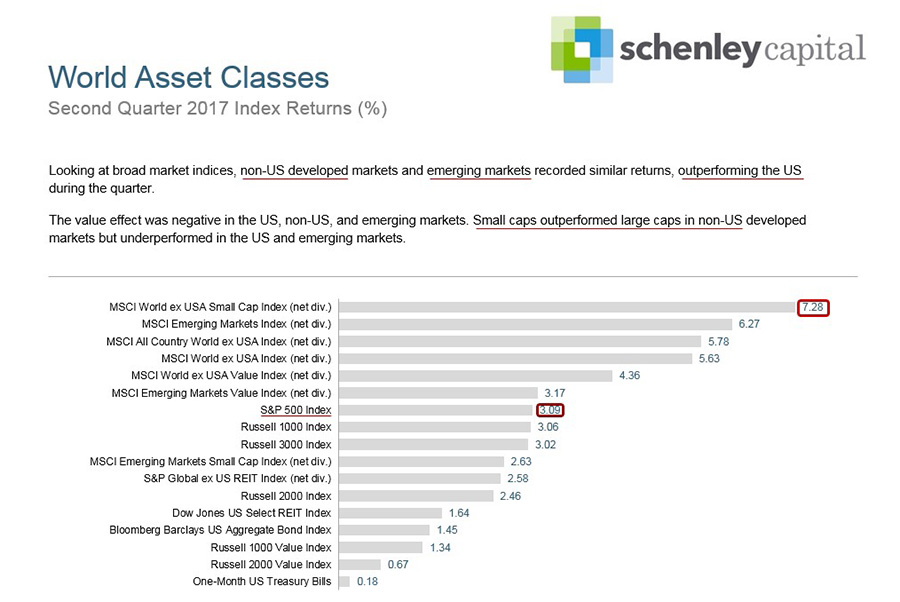
Below you can find some great graphics and charts showing a few top highlights for the 2nd Quarter of 2017

p@sswords

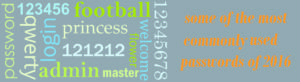
     Password security is a very important aspect of cyber security. Data breaches can occur when a password’s security level is low and the same password is used for multiple sites. By taking proactive measures towards password security, you are protecting yourself, your personal credentials, and your finances online!

     One great way to protect yourself online is to make sure you change your passwords for all your accounts including e-mails, your investments and bank accounts regularly. Many institutions require their employees change their passwords on a regular schedule of every six to eight weeks. This helps eliminate stale passwords and keeps company and personal data safe. In the instance that your password has become compromised and a data breach or hack has occurred, always change the passwords for not only that specific account right away, but all your other passwords as well. When you do change your passwords, make sure you use a different password combination for every site.

     Using separate passwords for each account you have online will make it harder for your other accounts to be hacked in the case that one of your passwords is compromised.  One simple way multiple accounts are compromised is when someone uses the same password for all their accounts. Once hackers obtain a password, they will enter that password and username combination for multiple sites, trying to gain access to as much as possible before they have been discovered. Choosing different passwords and log in usernames for each account adds a security layer for all your accounts, helping to prevent password theft.

When choosing a password, make sure it is lengthy, uses letters,

numbers, characters, and even using capital and lower-case letters

will make your password more secure.


One of the biggest mistakes in creating a secure password is using your name, address, a hobby, or a general commonly used password. Using a longer phrase or even a randomly generated combination of characters, numbers and letters will help keep your online accounts secure.


  The use of a password generator will help you to create a password that is secure. If you use a password authenticator app you will ensure your bank, credit card, and accounts are more secure. The authenticator generates numbers to type in after your secure password. These numbers will regenerate every 30 seconds and are tied only to your account, making it a very secure layer to add to your accounts. You can find some great password authenticators on the app store, on your Apple or Android phone.

     Schenley is very proactive concerning password security! We like to use best practices, such as changing passwords regularly. We use different password combinations, including characters, numbers and letters; in addition, we also use password authenticators to make sure our credentials and company files remain secure!

     Therefore, we advise you to create different passwords for each financial institution, make your passwords complicated and change your passwords regularly.


Written by: ||cassandra hartman, office manager||

Cyber Security… Are You Protecting Yourself and Your Investments?

     Cyber security is one of the biggest problems in the United States. Individuals are experiencing data breaches, as they are having their accounts compromised. Everyone is scrambling to make sure  that they’re accounts and information are secure. What is the best way to be more cyber secure? Many might not even know the small things they do daily may be placing their personal information at risk. What steps can you take to become more secure and where are you most at risk for an attack?
 
This week we’re going to do a series of blog posts to help our clients, potential clients and fellow blog readers stay secure and put up the best fight against these internet hackers!
 
     One great method for a cyber- attack is phishing. Phishing is the fraudulent practice of sending emails purporting to be from reputable companies to induce individuals to reveal personal information such as passwords, credit card numbers or bank account information. 
 
To help protect yourself from phishing do not succumb to the pressure of emails requesting personal confidential information.
 
      Banks and other companies such as credit card companies will never ask for account information via email. Utilities will also never ask for banking or account information via an email. Don’t get pressured into scare tactics and submit information that is confidential as well. Phishers will look to frighten you into submitting your account info.


-Never use links in an email to submit your personal bank or financial account information.

-You are safer to call the institution directly to submit your credentials.

-Phishing emails usually don’t look authentic and the hacker will try to mask themselves as a company. (For example- Docu-Sign or Drop Box)

-Never give out personal credentials thru an email.

-Always change your password for your email to a long combination of numbers, letters and characters as this will help prevent your email from becoming hacked.

 
     Many anti-virus companies have computer security programs that will help protect you against phishing. Remember, if the email doesn’t seem authentic or a request for personal information, your best choice is to delete the email. If a request is coming from a bank or financial institution, your best choice is to call and confirm with your financial advisor or bank representative about any account changes, money movement, personal information or account requests!
 
     Schenley is very sensitive to data requests! We make sure to check URL links before clicking them, check that all requests from any client are correct by speaking directly to them. We make sure to delete all phishing emails as soon as they are received. We take extra precautions to make sure our info and clients information is always safe from phishing attacks. 


Written by: ||cassandra hartman, office manager||